Sterilization in a healthcare facility: choosing a class B, N or S autoclave
14 July 2026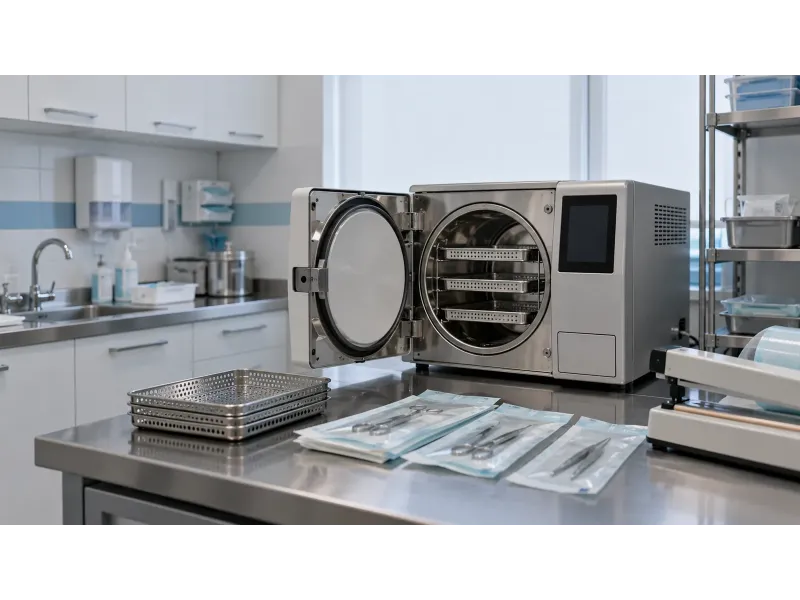
A medical autoclave bought today will spend most of its life under new rules. On 31 July 2025 Ukraine's Ministry of Health approved the State sanitary norms and rules on reprocessing of medical devices (order No. 1212, registered with the Ministry of Justice on 1 October 2025 under No. 1434/44840). They will replace the current rules approved by order No. 552 of 11 August 2014 and take effect two years after martial law is lifted or ends. The new norms say plainly what steam sterilizers must be, how to monitor them and what to do with dry-heat cabinets. Below we explain what that means for choosing a machine, how the B, N, S classes differ, and what else a sterilization room needs besides the autoclave.
What the new sanitary norms require of a steam sterilizer
These are the provisions that bear directly on equipment choice:
- large steam sterilizers must comply with DSTU EN 285, and small benchtop units with a chamber smaller than one sterilization unit with DSTU EN 13060:2018; the norms recommend small units for outpatient clinics and dental surgeries, as well as for sole practitioners;
- recommended cycles are 121 °C for at least 20 minutes or 134 °C for at least 5 minutes, but the sterilizer manufacturer's instructions always take precedence;
- fractionated vacuum air removal is used for all semi-critical devices and for critical devices of types A and B; gravity cycles are allowed only for decontaminating lab equipment, for liquids in sealed glass bottles and, exceptionally, for flash sterilization of unwrapped simple semi-critical items in rooms next to the operating theatre;
- sterilizers that cannot record or print the physical parameters (time, temperature, pressure) are banned unless the manufacturer supplies recording accessories;
- air removal is checked at minimum by a daily vacuum test before work starts and a weekly Bowie-Dick test;
- loads must come out dry: load weight may rise by no more than 1% for textiles and 0.5% for metal instruments.
An autoclave bought today will very likely still be running when the norms take effect. So buy a model with a vacuum cycle, a printer or electronic cycle records, and good drying. Meanwhile the European standard for small sterilizers has moved on to EN 13060:2025, although the Ukrainian norms still cite DSTU EN 13060:2018.
The B, N, S classes: what the letter means
EN 13060 defines the classes of small steam sterilizers. The UK guidance HTM 01-05 on decontamination in primary care dental practices (2013 edition) explains them this way. Class N removes air passively by steam displacement, has no vacuum and is meant for unwrapped solid instruments. Class B has a vacuum stage and is designed for hollow, air-retentive and packaged loads. Class S is for specific load types that the sterilizer manufacturer defines exactly.
The difference is practical. Steam that never reaches the inner channel of a handpiece, or the inside of a pouch, doesn't sterilize. The new Ukrainian norms also stress that air removal matters most for porous and textile items, and for hollow ones. So for dentistry, wrapped surgical sets or any instrument with a lumen, the main machine should be a class B autoclave. Class N works as a back-up for simple solid instruments used straight after the cycle.
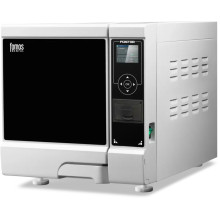
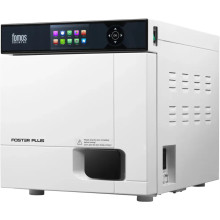
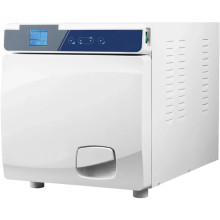
In the Finer catalogue class B is covered by the compact Foster Plus 8/12 L (8 or 12 L chambers), the larger Foster Plus 17/22 L with self-diagnostics and the benchtop MFO-8003, a 23 L unit with a thermal printer. There's also the Linea class N rated at 1800 W.
Chamber volume: where a small sterilizer ends
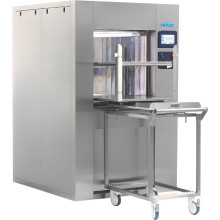
EN 13060 covers sterilizers with a chamber under 60 L that cannot take a 300 × 300 × 600 mm sterilization module. Anything that holds at least one module, or has a chamber of 60 L or more, is a large sterilizer under EN 285. A large unit such as the MBS horizontal steam sterilizer belongs in a hospital's central sterile department serving operating theatres. Its power and water supply, drainage, ventilation all go into the room design from the start.
For a benchtop medical autoclave, size follows workload: how many trays and pouches you get per shift and how many full cycles with drying fit into a working day. Take the full cycle time from the specific model's data sheet. Two 17 to 22 L units are sometimes handier than one big one, since one keeps working while the other is serviced.
Water quality, records, safety
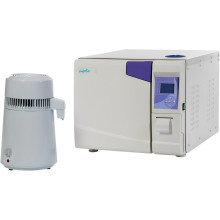
Feed water quality for small sterilizers is defined in Annex C of EN 13060. HTM 01-05 advises draining and cleaning the reservoir at the end of every working day and never leaving water in the machine overnight, because even high-quality water picks up microbial contamination. The new Ukrainian norms include a separate annex on demineralised water. Ask the supplier whether the model runs from a fill tank or needs a water treatment connection, and budget for a distiller or reverse osmosis unit.
Under the new norms record-keeping is continuous: on-screen graphs, a printout or an electronic record of every cycle. Chemical indicators follow DSTU EN ISO 11140-1:2019, and the Bowie-Dick test uses type 2 indicators under DSTU EN ISO 11140-3. Biological indicators under DSTU ISO 11138-1:2003 are used at least once a week. Steam sterilization is validated under DSTU EN ISO 17665-1:2014 and revalidated at least once a year. After a major repair, such as a vacuum pump replacement, or a change of water or steam source, the norms require the unit to be recommissioned.
An autoclave is pressure equipment, so the occupational safety rules for pressure equipment (Ministry of Social Policy order No. 333 of 5 March 2018) apply to it. Staff loading and unloading it wear heat-resistant gloves with goggles or a face shield.
Disinfection and sterilization of instruments: the autoclave is one step
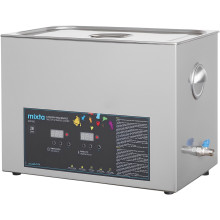
A badly cleaned instrument won't become sterile even in the best autoclave. The new norms recommend automated cleaning and state separately that ultrasonic cleaning is not disinfection. It's for items of complex shape, and only where the instrument manufacturer allows it. So alongside the autoclave you choose:
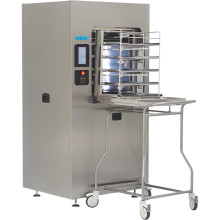
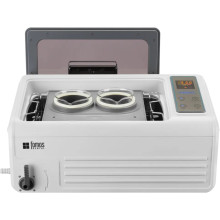
- washer-disinfection equipment such as the MYC for surgical instruments, or the MUY 1060 and Foclean ultrasonic cleaners;
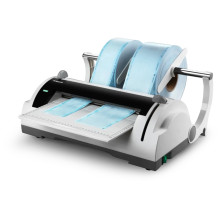
- the Foseal sealer for sterilization pouches;
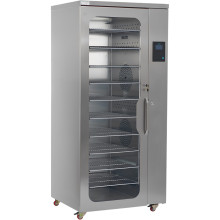
- drying and storage cabinets, for example the MAKD 1010 instrument cabinet or the EDS8 for flexible endoscopes;
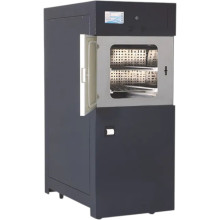
- a low-temperature sterilizer for heat-sensitive items that can't take steam: the MPS SERIES plasma sterilizer, the HF-LTPS100А/В or the VitroSteril HPS 80.
Can a dry-heat cabinet replace an autoclave?
No, and the new norms say so directly. A dry-heat (drying) cabinet with natural convection is for drying items and is not a sterilizer. Dry-heat sterilization is allowed only in exceptional cases, only in hot-air sterilizers with forced circulation, and only for items whose manufacturer permits it. If the instructions permit dry heat but give no cycle, the standard cycles apply: 180 °C for 60 minutes or 150 °C for 150 minutes. The head of the facility approves the list of such items. If dry heat is still your main method, start planning the move to a class B steam sterilizer now.
What to prepare before talking to a supplier
- A list of instruments and items: solid, hollow, textiles, heat-sensitive.
- How many trays and pouches you process per shift, and how many shifts a day.
- A plan of the sterilization room with dirty and clean zones, plus the available water supply, drainage, power.
- How you record cycles now, on paper or electronically.
- The indicators and packaging you use, so compatibility can be checked.
- Who will run the daily tests, and who will handle validation and service.
Equipment for the whole chain is in the Disinfection and sterilization section. If you're fitting out a sterilization room, an operating suite or a new clinic, see our turnkey solutions. Finer's doctors and engineers will match the autoclave and the rest of the line to your workload, prepare the quote and tender documents, then install, commission and train your staff. Call 0 800 334 585 or use the form on the contacts page.