How to choose an ultrasound machine for a clinic: cart-based or portable
19 May 2026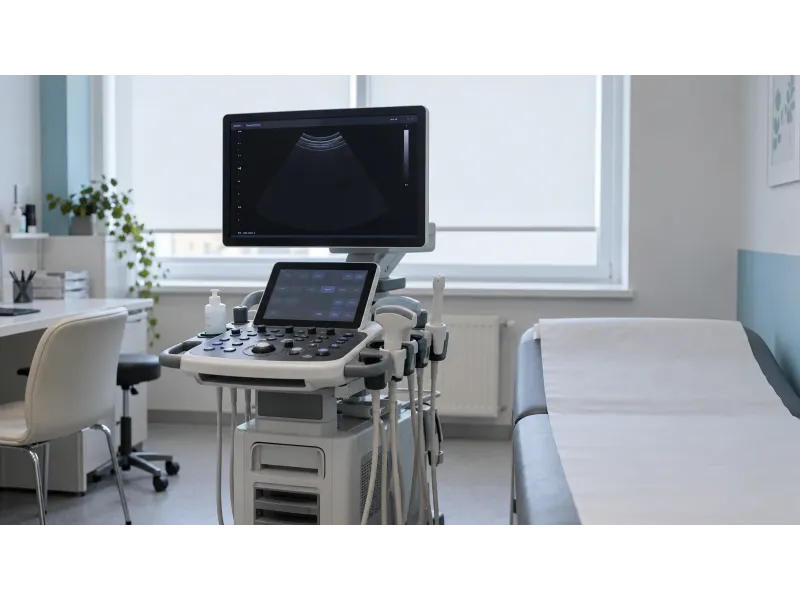
Choosing an ultrasound machine for a clinic usually comes down to two options. One is a cart-based system with a large monitor and several transducer ports. The other is a portable ultrasound machine the doctor carries to the ward, the emergency department or a home visit. "Cart-based is better, portable is cheaper" no longer holds: our catalogue has portable models in the expert class and compact cart systems. Below we look at choosing an ultrasound machine from the list of exams rather than the form factor, what to check on safety and transducer reprocessing, how the scanner should work with your archive, and when a clinic needs both types.
How a cart-based system differs from a portable one
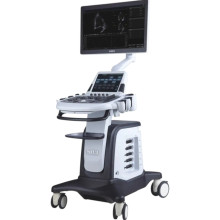
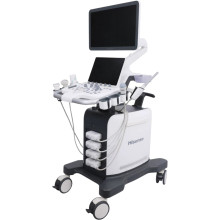
The difference isn't "image quality" as such. It's how the machine fits into the work. A cart-based system lives in the scanning room. It has a large monitor and a touch panel (21.3 inches on two models in our catalogue), several transducers connected at once, a height-adjustable console and usually more software packages. A sonographer doing twenty exams a shift sits at it for hours, so ergonomics count as much as resolution.
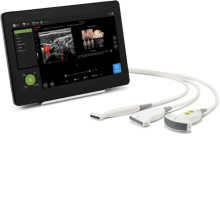
A portable ultrasound machine is light and runs on a battery. Our product cards for portable models list a built-in battery, in some cases good for up to 2 or up to 6 hours. You pay for mobility with a smaller screen and fewer transducers connected at once, and usually a narrower set of packages. The class of the machine no longer follows the form factor, though. The PILOTER is described as an expert-class system for urgent exams, the CLOVER 60 as an expert-class portable system with single-crystal transducers.
Start with the list of exams
The most useful thing a head of department can do before buying is write down the exams planned for the first year and where they'll be done. The form factor often follows on its own.
| Scenario | Transducers and modes | Form factor |
|---|---|---|
| Outpatient scanning room: abdomen, thyroid, breast, kidneys | Convex, linear, colour Doppler | Cart-based, mid-range |
| Obstetrics and prenatal diagnosis | Convex, endocavity, volume 3D/4D, obstetric package | Cart-based, high-end or expert class |
| Echocardiography | Phased array; PW plus CW Doppler; cardiac package | Cart-based |
| Vascular surgery, angiology | High-frequency linear, convex, full Doppler | Cart-based |
| ICU, emergency department, bedside exams | Convex, linear, phased array | Portable |
| Field work, mobile teams, home visits | Convex, linear | Portable or ultra-portable |
Bedside ultrasound is used more and more in emergencies. The European Resuscitation Council 2025 guidelines allow point-of-care ultrasound during advanced life support only in skilled hands, and only if it doesn't add to pauses in chest compressions. Used that way it can help identify treatable causes of cardiac arrest, such as cardiac tamponade or tension pneumothorax. So a portable unit in the resuscitation area has to start quickly and sit where nobody has to look for it.





Safety: the MI and TI indices, IEC 60601-2-37
Ultrasound involves no ionising radiation, but acoustic output has limits. The safety of diagnostic ultrasound systems is covered by IEC 60601-2-37, whose third edition came out in July 2024. During an exam the operator watches two numbers on screen, the mechanical index (MI) and the thermal index (TI).
The American Institute of Ultrasound in Medicine (AIUM) ALARA principle, most recently reapproved in August 2026, advises using the right presets and the lowest output that still gives a diagnostic image. It also asks operators to monitor MI and TI, to know the recommended limits and time restrictions, to take extra care with sensitive tissues, and not to hold the transducer still without reason. That gives you two procurement requirements. MI and TI must be displayed in every mode, on portable units too, and the presets must cover your exams, obstetric ones especially.
Transducers: reprocessing between patients and repairs
Transducers need their own plan. Under the AIUM guideline on transducer cleaning (2025 revision), internal transducers must undergo high-level disinfection between patients, with a high-quality single-use cover during each exam. External transducers used on intact skin need only low-level disinfection. The same guideline warns that not every agent suits every transducer. Some can be immersed up to the connector, others only at the scan head, and the array crystals can be damaged if the transducer rests on the bottom of the container.
In Ukraine, the new State sanitary rules on reprocessing of medical devices (Ministry of Health order No. 1212 of 31 July 2025) class devices that touch mucous membranes as semi-critical. The rules take effect two years after martial law ends, but it's worth planning endocavity probe reprocessing now. Ask the supplier for the list of disinfectants the manufacturer approves for each transducer, and tell them which high-level disinfection method your facility uses.
One more question for the quote: how transducer repairs work, whether a loan probe is available meanwhile, and who does planned maintenance. Portable units get dropped more often, which makes this even more pressing for them.
Archive and DICOM: working with the hospital information system
DICOM, the international standard for medical images (ISO 12052), is implemented in almost every imaging device, ultrasound included. For a clinic it means images and clips can go to a PACS or the hospital information system instead of a USB stick. Before buying, decide which DICOM services you need: storage, a Modality Worklist pulled from the information system, a structured report with measurements. Sometimes these are separate options, so request them for a portable unit just as you would for a cart. Check Wi-Fi or a network port separately, and how the scanner behaves offline, say on a home visit.


When a clinic needs both
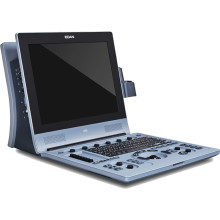
A typical set-up for a multidisciplinary clinic is a cart-based system in the ultrasound room for scheduled patients and a portable unit that serves the wards, the ICU, the emergency department. The portable doesn't take scanning-room time for urgent exams, and the cart doesn't get pushed down corridors. A small private clinic with one sonographer can sometimes manage with one machine, and then the choice depends on whether there will be home visits. Cart-based models in our catalogue include the Apogee line (3500, 5300, 5500) for a broad range of exams, the expert-class Apogee 6500 and the compact Q40. Besides PILOTER and CLOVER 60, the portables include the mid-range U60, the APOGEE 2300 and the DRAMIŃSKI BLUE with Doppler for emergencies.
What to prepare before talking to a supplier
- The list of exams for the year and the expected number of patients a day.
- Where the machine will work: scanning room, wards, ICU, home visits.
- The transducers and software packages you need: Doppler, cardiac, obstetric, 3D/4D, elastography.
- Who will use the machine, and whether on-site training is needed.
- Your hospital information system or PACS, and the DICOM services required.
- The method your facility already uses for high-level disinfection of endocavity probes.
Prenatal rooms often pair ultrasound with fetal monitors, and the rest of our diagnostic range is under Diagnostic equipment. If you're equipping a diagnostic department or a new clinic, see our turnkey solutions. Finer's doctors and engineers will help match the model and transducer set to your exams, prepare the quote and tender documents, commission the machine and train your staff. Call 0 800 334 585 or visit the contacts page.